

ALLOY
KS111 Carbide
KS111 超硬合金A proprietary blend, rebalancing nickel and tungsten carbide for toughness as well as hardness. Developed and produced with Nippon Tokushu Gokin, supplied as 2 mm plate.
The vision of Japan's greatest knifemaking engineers, made from one of the hardest materials on earth.
For 130 years Fukuda Hamono has made blades in Seki — some longer than five meters, intended for the world's most demanding industrial uses. KISEKI: is the first time they made one small enough to hold: the world's first mass produced cemented tungsten carbide kitchen knife, with handles cut from Gifu hardwoods.
For 130 years Fukuda Hamono has made blades in Seki — some longer than five meters, intended for the world's most demanding industrial uses. KISEKI: is the first time they made one small enough to hold: the world's first mass produced cemented tungsten carbide kitchen knife, with handles cut from Gifu hardwoods.
Keisuke, head of engineering at Fukuda Hamono, cooked over open fires long before camping became trendy in Japan — and every time he picked up a knife, he hit the same wall. Carbon steel cuts beautifully but rusts and demands care. Stainless keeps its edge but never quite satisfies. No knife gave him both.
His company could make almost any blade. Around ten thousand fully bespoke industrial orders pass through the Seki works every year. The one thing they had never made was a kitchen knife.
Then came cemented carbide: a tungsten-carbide alloy second only to diamond in hardness, and notoriously hard to shape. Traditional smithing could not turn it into a knife. A team of engineers used to working on blades longer than a car set out to make one about eighteen centimetres long.
Two years and over a hundred costly failed blanks later, they took prototypes to a creative Japanese kitchen in Seki and watched the chefs work. The chefs stayed — and became the project’s fiercest critics and supporters.
Carbide is nearly twice as heavy as iron, ignores magnets and resists rust — but it cracks under a press and splinters under a drill. So the Seki team replaced each traditional step with a precision one, and wrote two patents and a design registration along the way.
A proprietary blend, rebalancing nickel and tungsten carbide for toughness as well as hardness. Developed and produced with Nippon Tokushu Gokin, supplied as 2 mm plate.

Stamping cracks it and lasers aren’t precise enough, so blanks are wire-EDM cut at one thousandth of a millimeter precision — forty at a time, ten hours per batch, with no heat distortion.
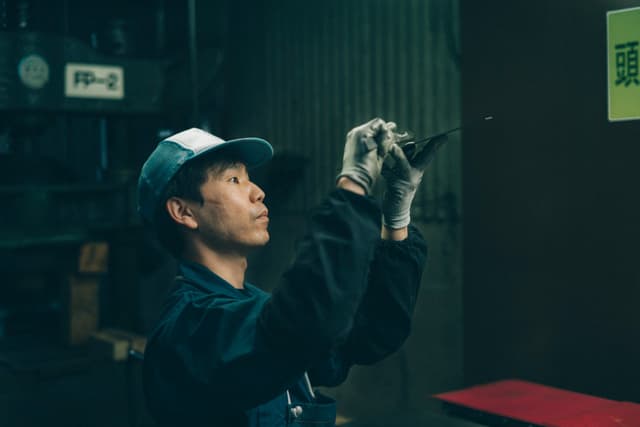
About thirty minutes of CNC grinding per blade, from data won through 100+ prototypes. A three-facet edge, finished with a “spark-out” pass that guards against chipping.

3 options of fine Japanese hardwoods: mizunara, yamazakura or buna, grown in Gifu, 3D-machined and urethane-finished in the Seki factory, with a fine texture on the bolster for grip.

Drilling carbide risks micro-cracks, so the blade is held by an injection-moulded, glass-fibre-reinforced polyamide bolster — a material from high-end survival knives — developed with a local Gifu firm.
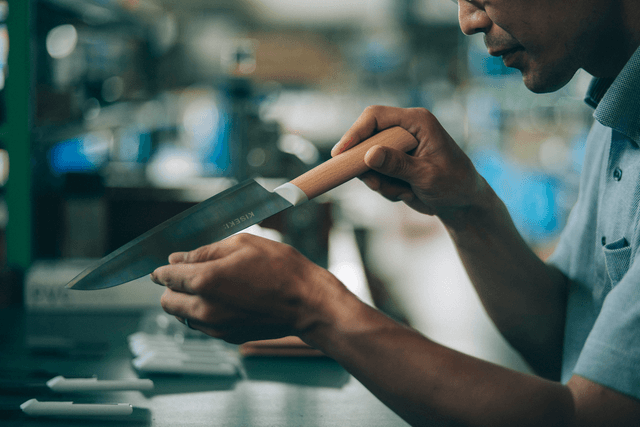
So every customer gets the same edge, each finished knife is inspected on a 3D shape-measuring machine and checked by hand before it leaves Seki: quality control to the thousandth of a millimetre.
A knife that cuts like carbon steel and keeps its edge like nothing else.
The two-year trail of a team of engineers working it out together.
A wish for their hometown’s blade-making to be seen by the world again.